

This is the home-made TEA (Transverse Excitation of Atmosphere) laser, I built in the basement.
It produces repeated powerful laser-pulses of ultra-violet light (337.1 nm), which show up when the beam-spot
hits paper. It's very noisy, since it uses a spark-gap trigger I hope to replace that with a thyratron or
a krytron tube. The high-voltage capacitor, is made with aluminum foil, and thin mylar sheets. The
electrical rails are made from a carpet-edge metal strip, sourced from Home Depot. The power-supply is
a Molectron unit made by Universal Voltronics, and was sourced on eBay, from North Carolina, back in
2006. It was borrowed from the IEC fusion reactor. (I've run out of deuterium. And my expensive
vacuum-pump needs to be cleaned, and the confinement grid is grunged up. No neutrons, for now. Darn.)
So, I built a TEA laser for some fun.
(Click to enlarge image, ESC to exit image enlargement.)
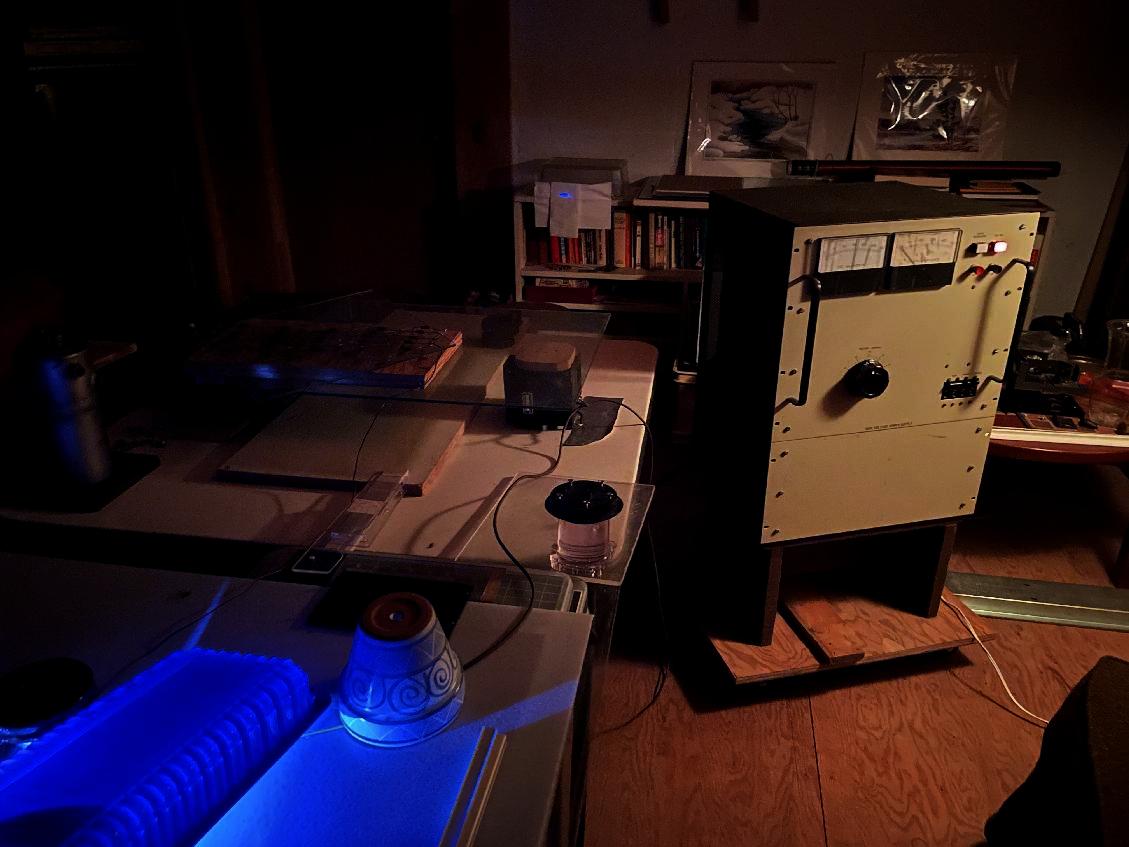
[ Fun with Latest Version of Homemade Nitrogen TEA Laser - Oct. 7, 2025 ]
The Nitrogen TEA (Transverse Excitation, Atmospheric) Laser was rebuilt to be smaller. The beam-rails on this version of my TEA Laser, are only 6-inches long, and the entire area of the capacitor is the size of a piece of note-pad paper. The TEA Laser lases air - specifically the nitrogen gas in the air. It's very hard to make it work, but when you get it configured, it is a "super-radiant" kind of laser which does not need mirrors. The beam is ultraviolet light, invisible until it strikes a surface that will then glow. I already had the big power-supply, and the laser itself is very easy to construct. The air is roughly 73 percent nitrogen, so you can actually lase air! The first article about making these kinds of lasers, appeared in Scientific American magazine, back in 1974. My earlier version had laser-electrode rails of almost 3 feet in length. The new version has laser rails that are only 6-inches in length, and a much smaller capacitor area, yet it seems to work well. :) (Click on image to expand, ESC or click outside image to exit)
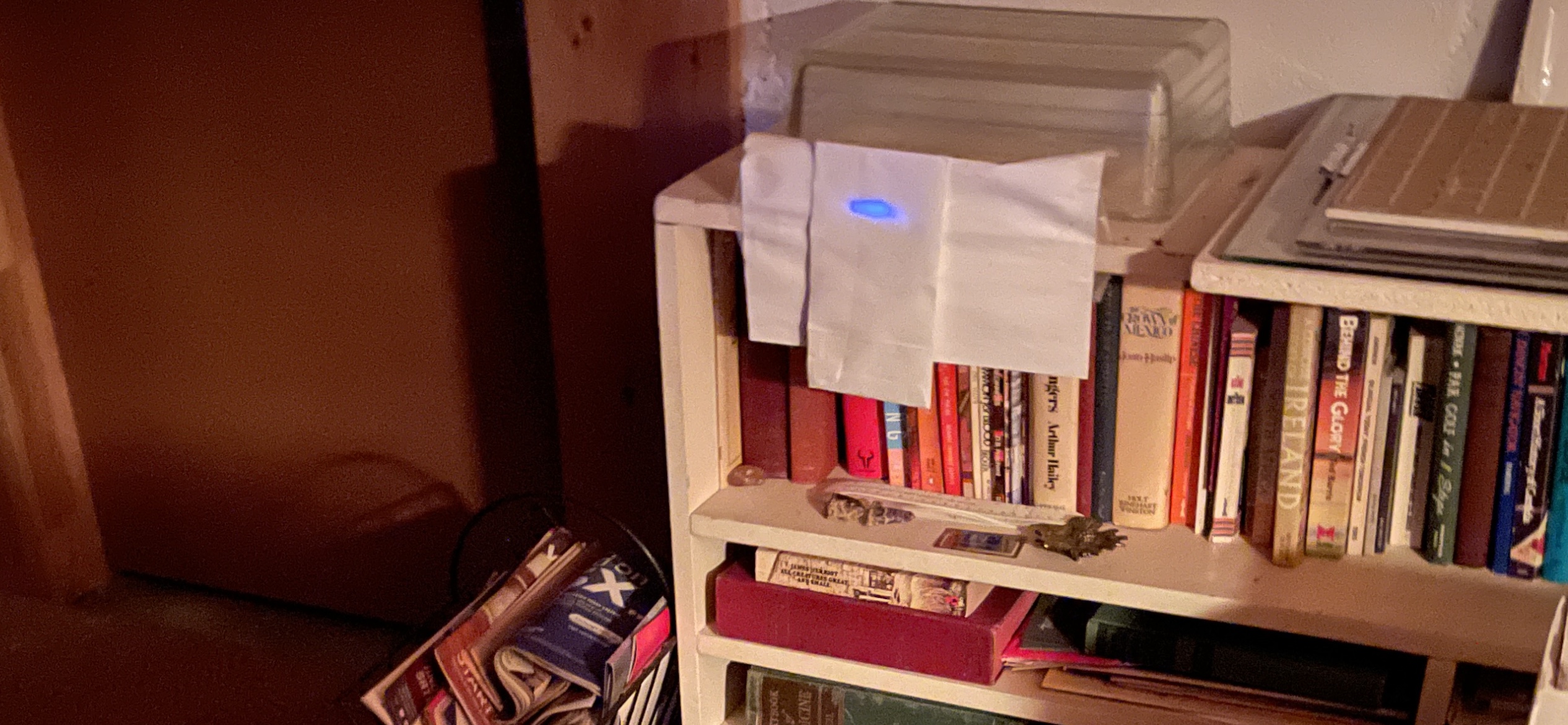
[ Closeup of the Beamspot from the Small N2 TEA Laser on Back of Plain Envelope - Oct. 7, 2025 ]
The N2 TEA Laser is interesting - especially the smaller one I just built. The beamspot, on a plain white envelope, is blue-violet, even though the beam is invisible, because it is in the ultraviolet (337.1 nm), but it will typically make white paper glow. The iPhone camera seems to be quite sensitive to ultraviolet, and so it shows a bright image in this closeup. The beam displays an interesting dispersion, which looks to be an artifact of the laser's super-radiant operational feature. The beamspot appears to almost be an optical Gaussian distribution. I find these N2 TEA (Transversely Excited Atmospheric) lasers quite interesting, since air itself is the medium that is being stimulated by the high-voltage electromagnetic pulse from the laser rails, to create the laser pulse. (Click on image to expand, ESC or click outside image to exit)